

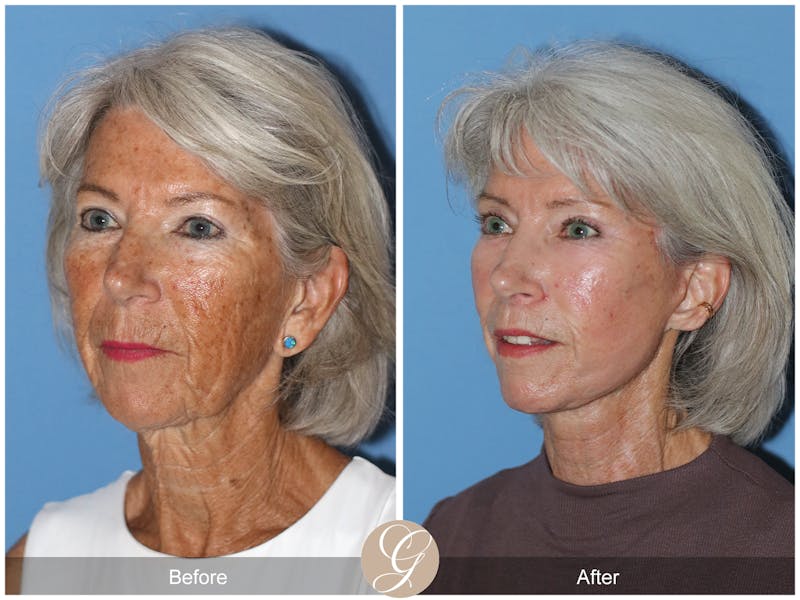
One of the most common questions I hear from patients is, “Does a deep plane face and neck lift hurt?” The honest answer is that for most of my patients, it does not. This is not by accident. Pain control begins before surgery and continues throughout the entire surgical and recovery process. One week before surgery, my patients begin taking Arnica Montana, a natural supplement that medical studies suggest can help reduce bruising, swelling, and inflammation. Two days before surgery, we introduce tramadol, a non-narcotic medication that lowers pain perception by calming central pain pathways. This preemptive approach helps prevent pain amplification and contributes to a smoother, more comfortable recovery without heavy reliance on narcotic medications. Our rapid recovery protocol further helps reduce inflammation and pain. One day prior to surgery, patients receive Hyperbaric Oxygen Therapy to optimize tissue oxygenation and healing. Before and after surgery, ElixirMD photobiomodulator therapy is used to reduce inflammation and support cellular recovery. Before surgery begins, patients also receive a dose of TXA (tranexamic acid) to help prevent bleeding during surgery and minimize bruising afterward.
I perform my deep plane facelifts under twilight sedation rather than general anesthesia. With general anesthesia, the body is fully asleep and paralyzed, but the brain can still register pain signals if the face is not completely numbed. Many surgeons inject numbing medicine only along the skin incision lines and not throughout the deeper facial tissues that are lifted during surgery. This often leads to greater postoperative pain and the need for strong narcotic medications that can cause nausea, vomiting, dizziness, and grogginess. With my twilight sedation protocol, patients are deeply relaxed and breathing on their own, but not unconscious. As soon as the patient lies on the operating table, my anesthesiologist administers Versed, Propofol, and a small dose of ketamine to create a brief dissociative state before any local anesthetic is injected. Because of this, the brain never registers the sting of the numbing medicine. When the brain does not experience that initial pain signal, it does not become sensitized later. This process is known as preventing pain wind-up. It makes recovery much easier.
Another reason my patients experience less pain is the surgical technique itself. I use a preservation deep plane facelift performed in a tension-free manner. The facial tissues are fully released and repositioned to their natural anatomical location. They are gently secured without pulling or stretching. Stretching muscle and soft tissue is one of the biggest causes of postoperative pain. Eliminating tension significantly reduces discomfort and improves healing. Before patients wake up, I inject a long-acting numbing medication called Marcaine. This provides pain control for more than ten hours after surgery, which is the most important period for comfort. I also do not use drains for my preservation deep plane facelift, since the drain itself can cause pain and discomfort after surgery.
After surgery, we rely primarily on non-narcotic medications such as Tylenol, Celebrex, and tramadol. These medications work together to reduce inflammation and control pain without the side effects of strong opioids. Because the tissues are tension-free and already numbed, most patients never need powerful pain medication at all. Every face and neck lift patient recovers in a private aftercare facility as part of our surgical protocol. A trained nurse provides one-on-one care, helping with icing, comfort, reassurance, and close monitoring throughout the first night. The goal is not to chase pain with narcotics after surgery. The goal is to prevent it from ever starting. Through specialized sedation, gentle surgical technique, long-lasting numbing medicine, rapid recovery therapies, non-narcotic pain control, and dedicated nursing care, we dramatically reduce how much pain the brain ever perceives. This is why so many of my patients are surprised by how comfortable their recovery truly is.